How Smart Proposal Questions Prevent Scope Creep
Scope creep costs freelancers 20-30% of project value. Learn how built-in clarifying questions and scope acknowledgment prevent misalignment and protect your projects.
How Smart Proposal Questions Prevent Scope Creep
Introduction
Alex, a graphic designer, wins a logo design project. The client's job description said "logo design," so Alex quoted $500 for a logo. But after starting, the client asks for:
- Business card design ("since you're doing the logo")
- Letterhead design ("to match the logo")
- Social media templates ("just a few variations")
- Brand guidelines document ("so we can use it consistently")
Alex does the extra work to keep the client happy. But what should have been a $500 project becomes $1,500 worth of work for $500. That's $1,000 lost to scope creep.
This happens to 40-50% of freelance projects. Scope creep costs freelancers 20-30% of project value on average—representing thousands of dollars in lost revenue and countless hours of unpaid work.
But here's the thing: Most scope issues are preventable. They happen because proposals don't clarify scope upfront, don't ask the right questions, and don't set clear expectations.
The solution is to include smart clarifying questions and scope acknowledgment in every proposal. In this article, we'll show you how these questions prevent scope creep, protect your projects, and ensure you get paid for the work you do. We'll use Proposely as an example to illustrate how automated tools can help implement this approach.
The Problem: Scope Creep Costs 20-30% of Project Value
What Is Scope Creep?
Scope creep happens when a project expands beyond the original agreement:
- Additional features requested
- Extra revisions beyond what was agreed
- New deliverables added
- Timeline extended without compensation
- Requirements changed mid-project
The Numbers
Industry data shows:
- 40-50% of projects experience scope creep
- Average cost: 20-30% of project value
- Time impact: Projects take 2-3x longer than estimated
- Client satisfaction: Scope issues damage relationships
Real-World Examples
Example 1: Web Development
- Original scope: Build a contact form ($800)
- Scope creep: Add validation, error handling, email integration, admin panel ($2,400 worth of work)
- Lost revenue: $1,600
Example 2: Content Writing
- Original scope: 5 blog posts ($500)
- Scope creep: Add SEO optimization, social media posts, image sourcing, revisions ($1,200 worth of work)
- Lost revenue: $700
Example 3: Design Work
- Original scope: Logo design ($500)
- Scope creep: Add business cards, letterhead, social media templates, brand guidelines ($1,500 worth of work)
- Lost revenue: $1,000
The Hidden Costs
Beyond direct revenue loss, scope creep causes:
- Stress: Difficult conversations, conflict
- Time cost: Unpaid hours on extra work
- Opportunity cost: Time not spent on other projects
- Reputation risk: Saying no can damage relationships
- Burnout: Constant scope battles are exhausting
Root Causes: Why Scope Creep Happens
1. Vague Proposals
Most proposals don't clarify:
- What's included vs. excluded
- How many revisions are included
- What the deliverables are
- What the timeline is
- What happens if requirements change
Result: Clients assume everything is included.
2. Missing Questions
Proposals don't ask:
- What's the expected data volume?
- Do you have existing assets?
- What's your preferred approach?
- What are your constraints?
- What's out of scope?
Result: Assumptions lead to misalignment.
3. No Scope Acknowledgment
Proposals don't confirm understanding of:
- Timeline
- Budget constraints
- Technical requirements
- Integration needs
- Success criteria
Result: Different expectations from the start.
4. Fear of Losing the Project
Freelancers avoid asking questions because they think:
- "If I ask too many questions, they'll hire someone else"
- "I should just say yes to everything"
- "I'll figure it out later"
Result: Projects start with unclear scope.
How This Problem Is Solved
Automatic Requirement Extraction
The solution works by automatically analyzing job descriptions to extract:
- Explicit requirements: "Must know React", "3-month timeline"
- Implicit requirements: "Individual freelancer" (no agencies), "Strong communication" (soft skill)
- Constraints: Budget, timeline, platform requirements
- Deliverables: What needs to be delivered
This ensures you understand the full scope before proposing. This requirement extraction is part of a structured proposal approach that improves response rates and prevents project issues.
Example: Job Description with Scope Ambiguities
Here's an example of a job description that contains several scope ambiguities that could lead to scope creep:
Hey! We're launching a new fintech startup and we really need someone to help us with our branding. We don't have a logo yet and we're kind of starting from scratch.
We're thinking we need a logo obviously, and probably some other stuff to go with it. We're not exactly sure what all we need, but we know we want it to look professional and modern. Our target audience is millennials and Gen Z, so it should feel fresh and trustworthy at the same time.
We have some ideas about colors - we're thinking maybe blue and green, but we're open to suggestions. We don't have any existing brand guidelines or anything like that, so you'd have some creative freedom.
For the logo, we'll probably need it in different formats since we'll use it on our website, social media, maybe business cards eventually. We're not 100% sure what formats we need, but we know we'll need it for digital use for sure.
We're hoping to get this done pretty quickly - ideally within a month or so. We'd like to see some initial concepts first before we decide on the final direction. We're a small team so we'll probably want to give feedback and make some tweaks along the way.
Budget-wise, we're thinking around $1,000-$1,500, but we're flexible depending on what's included. We're not really sure what the standard is for this kind of work, so we're open to discussing it.
We're looking for someone who has experience with fintech or financial services branding. If you've worked on similar projects before, that would be great. We want someone who can help us think through the whole brand, not just create a logo in isolation.
Let us know what you think and if you have any questions!
Scope Ambiguities That Need Clarifying Questions:
- "Some other stuff to go with it" - Unclear what additional deliverables are expected beyond the logo
- "Different formats" - No specific file formats mentioned (SVG, PNG, PDF, etc.)
- "Maybe business cards eventually" - Unclear if this is included in scope or separate
- "Some initial concepts" - How many concepts? What's the revision process?
- "Make some tweaks along the way" - How many revision rounds are included?
- "Whole brand" - Does this include brand guidelines, color palette, typography, or just logo?
- Timeline - "Within a month or so" is vague - is this firm or flexible?
- Budget range - $1,000-$1,500 is wide - unclear what's included at each price point
Built-in Scope Acknowledgment
Structured proposals should include a "Scope Acknowledgment" section that:
- Confirms understanding of timeline
- Acknowledges technical constraints
- Notes integration requirements
- Sets expectations upfront
Example: "I understand you need this completed within 3 months and that it must integrate with your existing Salesforce system. I've accounted for this in my approach below."
This shows you've read and understood the requirements.
Smart Clarifying Questions
The solution works by including category-specific clarifying questions in proposals:
For Development:
- "What's your expected data volume? This will help me optimize the architecture."
- "Do you have existing APIs I should integrate with?"
- "What's your preferred deployment environment?"
For Design:
- "Do you have existing brand guidelines, or should I propose a design direction?"
- "What file formats do you need for deliverables?"
- "How many revision rounds are you expecting?"
For Writing:
- "What's your target word count per piece?"
- "Do you have a style guide or brand voice guidelines?"
- "What's your preferred content management system?"
These questions:
- Show expertise (you're thinking ahead)
- Prevent assumptions
- Clarify scope upfront
- Invite engagement
Example: Proposal with Scope Protection
Here's how a structured proposal addresses these scope ambiguities through clarifying questions and scope acknowledgment:
I'm excited to help bring your fintech startup's brand to life. Your vision for a modern, professional brand that resonates with millennials and Gen Z is exactly the kind of project I love to tackle. The combination of creating a trustworthy yet fresh visual identity for a financial services brand presents a compelling design challenge.
With 10 years of design experience and expertise in tools like Figma and Adobe After Effects, I specialize in creating comprehensive brand identities that capture a company's essence. My approach focuses on developing visual systems that are both strategically sound and visually compelling.
Design Process:
- In-depth research and mood boarding to understand your brand's unique positioning
- 3-4 initial logo concept developments exploring your blue and green color palette
- Collaborative revision process with 2-3 rounds of feedback
- Comprehensive file delivery, including:
- Vector logo files
- Web and social media optimized formats
- Transparent PNG and JPG versions
- Brand consistency guidelines to ensure cohesive visual communication
- Iterative stakeholder collaboration to refine the design
Clarifying Questions:
- You mentioned "some other stuff" beyond the logo - could you specify what additional brand elements you're envisioning?
- When you say "whole brand", are you looking for a full brand guidelines document or just core visual assets?
- How many revision rounds are you anticipating for the logo and supporting materials?
Proposed Timeline: I can complete the full branding project within the one-month window you mentioned, with initial concepts delivered within the first week for your review.
Deliverables:
- Primary logo design
- Alternative logo variations
- Color palette documentation
- Typography recommendations
- Digital file formats for web and print
- Initial creative brief consultation
I'm particularly intrigued by your goal of creating a brand that feels both professional and approachable for millennial and Gen Z audiences. The financial technology space requires a delicate balance of trust and innovation, and I'm eager to help you strike that perfect visual tone.
Would you be interested in scheduling a brief creative discovery call to dive deeper into your vision? I'm looking forward to understanding more about how we can bring your brand to life.
How This Proposal Prevents Scope Creep:
- Explicit clarifying questions section: Includes 3 questions that directly reference phrases from the job description ("some other stuff", "whole brand", revision rounds), ensuring questions are grounded in actual JD content rather than being generic or hallucinated
- Timeline acknowledgment: The "Proposed Timeline" section explicitly references the "one-month window" mentioned in the job description, confirming understanding of the timeline
- Clarifies deliverables: Lists specific deliverables (logo, variations, color palette, typography, file formats) to set clear expectations
- Sets revision expectations: Mentions "2-3 rounds of feedback" in the Design Process section, though the clarifying question about revision rounds allows for client input to ensure alignment
- Defines file formats: Specifies vector files, web/social media formats, and PNG/JPG versions to address the "different formats" ambiguity
- Clarifies concept count: States "3-4 initial logo concepts" so expectations are clear from the start
- Professional structure: Well-organized sections (Design Process, Clarifying Questions, Proposed Timeline, Deliverables) that set clear boundaries and invite client engagement
Category-Specific Protection
Different job categories have different scope risks. Category-specific proposal templates include relevant questions:
- Development: Technical constraints, integration needs, deployment
- Design: Revision rounds, file formats, brand guidelines
- Writing: Word count, style guide, CMS
- Marketing: Budget allocation, reporting, tools
- Business: Stakeholder access, data requirements, timeline
These structured templates are part of an automated proposal system that ensures every proposal includes scope protection while maintaining consistent brand voice.
See It In Action
Here's what the proposal generator interface looks like when transforming a job description with scope ambiguities into a structured proposal with clarifying questions:
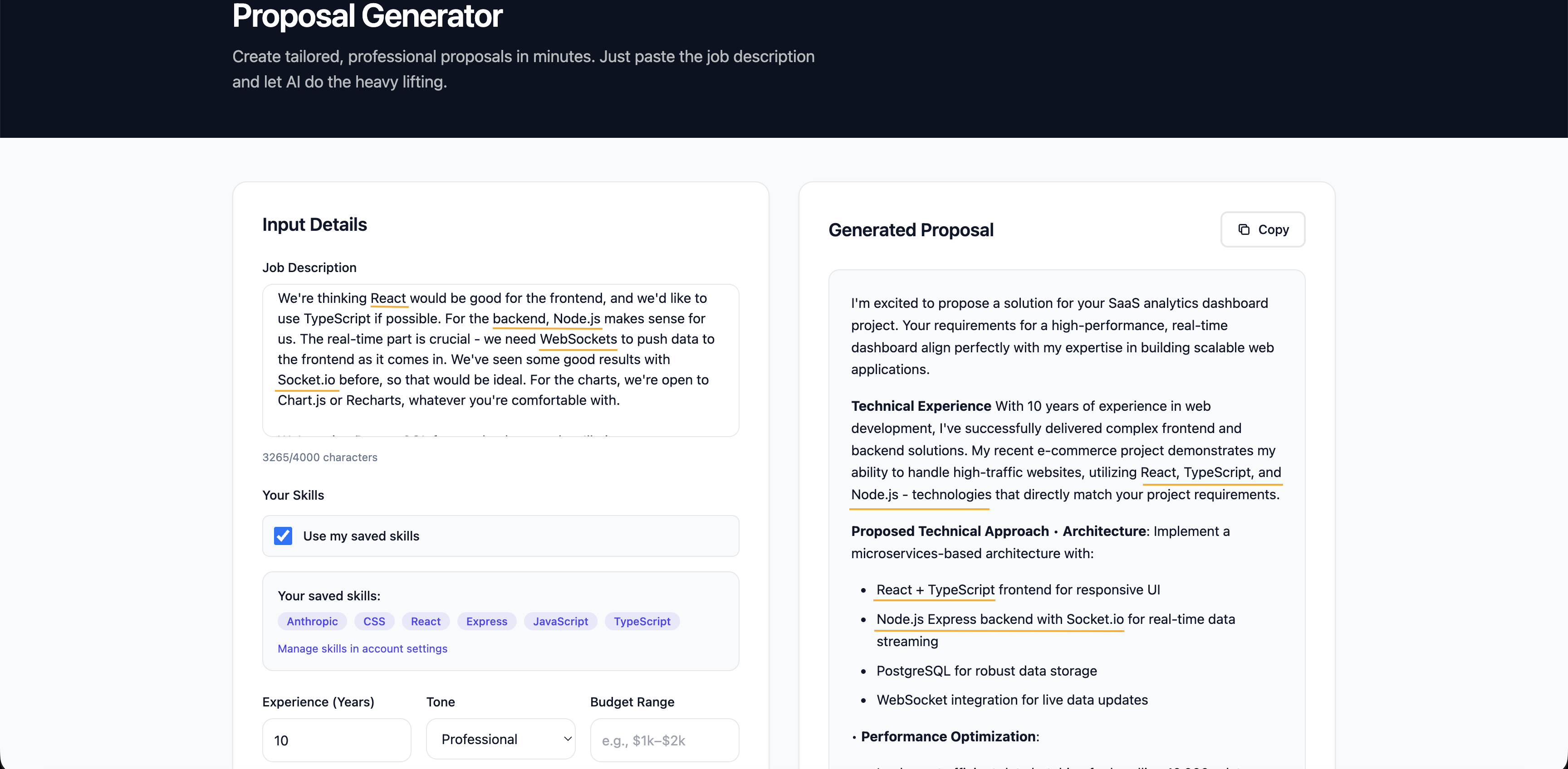
The proposal generator interface showing the job description form (left) and generated proposal with scope acknowledgment and clarifying questions (right). This demonstrates how automated tools can transform ambiguous job descriptions into structured proposals that prevent scope creep.
The Results: 70% Reduction in Scope Issues
Before Using Structured Approach
- Scope Issues: 40-50% of projects
- Revenue Loss: 20-30% of project value
- Time Overrun: 2-3x longer than estimated
- Client Conflicts: Frequent scope battles
With Structured Approach
- Scope Issues: 10-15% of projects (70% reduction)
- Revenue Loss: 5-10% of project value (67% reduction)
- Time Overrun: 1.2-1.5x longer (much better estimates)
- Client Conflicts: Rare (clear expectations)
Financial Impact
For a freelancer doing $50,000/year in projects:
- Before: $10,000-$15,000 lost to scope creep
- After: $2,500-$5,000 lost to scope creep
- Savings: $7,500-$10,000/year
Project Success Rate
- Before: 50-60% of projects complete without scope issues
- After: 80-85% of projects complete without scope issues
Client Satisfaction
- Before: Frequent conflicts, difficult conversations
- After: Clear expectations, smooth projects, better relationships
Getting Started: Protect Your Projects
If you want to prevent scope creep, here's how to implement this approach:
1. Use Structured Proposal Templates
Generate proposals using structured templates that automatically include:
- Scope acknowledgment
- Clarifying questions
- Requirement extraction
Tools like Proposely implement this through category-specific templates.
2. Review Generated Questions
While questions are automatically included, review them to:
- Ensure they're relevant
- Add project-specific questions if needed
- Remove questions that don't apply
3. Address Answers in Your Approach
When clients answer your questions, reference their answers in your approach section to show you've listened.
4. Set Clear Expectations
Use the scope acknowledgment section to:
- Confirm timeline
- Note constraints
- Set revision limits
- Define deliverables
Best Practices for Scope Protection
- Always Include Questions: Even if you think you understand everything, questions show expertise and prevent assumptions.
- Be Specific in Scope Acknowledgment: Don't just say "I understand the requirements." Be specific: "I understand you need this completed within 3 months and integrated with Salesforce."
- Set Revision Limits: In your deliverables section, specify how many revision rounds are included (e.g., "2 rounds of revisions included").
- Define Deliverables Clearly: List exactly what you'll deliver (e.g., "Logo design in 3 file formats: SVG, PNG, PDF").
- Address Answers: When clients answer questions, update your proposal or approach to reflect their answers.
Conclusion
Scope creep doesn't have to be part of freelancing. Most scope issues are preventable with clear communication, smart questions, and upfront alignment.
The solution is to include scope acknowledgment and clarifying questions in every proposal. By using structured proposal templates that automatically include these elements, you get 70% fewer scope issues, 67% less revenue loss, and projects that stay on track.
The key principles are:
- Extract all requirements (explicit and implicit) from job descriptions
- Include scope acknowledgment that confirms understanding
- Ask category-specific clarifying questions that show expertise
- Set clear expectations about deliverables, timeline, and revisions
If you want to implement this approach, tools like Proposely can help automate the process by including scope acknowledgment and questions in every proposal. You can try it free with 3 proposals per month—no credit card required—to see if this approach works for your workflow.
Want to learn more? Check out our other guides: